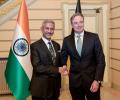
The era where nations thrived through rigid alignments is giving way to an age where the connective State defines power. For India, that era has arrived, points out Dr Nishakant Ojha.

An Indian commerce ministry team has reached Washington for another round of talks from Monday on the proposed bilateral trade agreement (BTA), an official said. Chief negotiator of India and special secretary in the Department of Commerce, Rajesh Agrawal, will join the team on Wednesday.

"My understanding is that the rules are weighted in favour of big cars, even though smaller cars emit fewer emissions per passenger, use less material, and consume less fuel," Bhargava said in an interview with Business Standard.

The escalation of conflict in the West Asian region is expected to push already high logistics costs besides hurting trade in sectors such as oil, electronics and agriculture, according to exporters. They said that insurance costs for exports to the countries directly involved in the war could also go up, which will impact Indian exporters' working capital. Think tank Global Trade Research Initiative (GTRI) stated that the conflict is already hurting India's trade with countries like Israel, Jordan, and Lebanon.

This might help explain why our global outreach has received such a tepid response. We have chosen to be transactional with the world, as our UN votes reveal, points out Aakar Patel.

On a five-day rolling basis, FPI selling is the highest in 24 years.

'The US values its relationship with India and under the strong leadership of President Donald J Trump and Prime Minister Modi, I am optimistic about the days ahead for both of our nations.'

A few years ago, when top officials of Indian state-run refiners went to Dubai to negotiate a crude oil supply contract, a senior official from state-owned Saudi Aramco told them, "We can negotiate on anything, but I am the last man standing for you. "Nobody can offer the range of crudes we do with certainty," an official who was part of the negotiating team recalls. Perhaps that explains why Saudi Arabia is less concerned about losing its place as India's premier oil supplier to an upstart like Russia, which emerged from nowhere to become India's biggest crude oil supplier in September and October.

Indian officials will focus on expanding the country's footprint in oil-rich Siberia when they meet their Russian counterparts at the four-day 7th Eastern Economic Forum beginning Monday in Vladivostok. The two sides will discuss the possibility of joint oil exploration in the area and cooperation in running offshore oil and gas fields Western companies are in the process of exiting, officials said in New Delhi. Pavan Kapoor, India's ambassador to Russia, will lead the official-level talks at the summit scheduled September 5-8.

India will not provide any duty concessions on British wines and is offering only limited import duty benefits on UK beer under the free trade agreement (FTA) between the two countries, announced on May 6, according to an official. The other sensitive agri products where India will not offer any reduction in the import duty include dairy products, apples, cheese, oats, animals and vegetable oils under the agreement with the United Kingdom.

'I do believe there will be a resolution in the next couple of months on the penal tariff and hopefully on the reciprocal tariff also.'

External Affairs Minister S Jaishankar on Monday met United States Secretary of State Marco Rubio for bilateral discussions, as the high-level 80th session of the United Nations General Assembly (UNGA) kicks in.

Savings for Indian refiners from purchasing Russian oil have decreased to a third of what they were in the years following Russia's invasion of Ukraine, which triggered global crises, sanctions, and discounted Russian oil seeking buyers. Despite this, savings from importing cheap Russian oil were significant enough to help Indian refiners tide over frozen petrol and diesel pump prices.

Equity benchmark indices Sensex and Nifty ended lower on Thursday after US President Donald Trump announced the imposition of a 25 per cent tariff on all goods coming from India starting August 1 and an unspecified penalty for buying Russian crude oil and military equipment.

The point to note for India is that we must not panic. The United States may be our largest export destination, but high tariffs will not exactly mean gloom and doom. Sure, we can throw some morsels as we continue negotiating, but we must be firm that some red lines cannot be crossed, no matter what, asserts Shreekant Sambrani.

Russia has welcomed India's decision to not support the price cap on Russian oil announced by G7 and its allies and offered it cooperation on leasing and building large-capacity ships to overcome the ban on insurance services and tanker chartering in the European Union and Britain to continue buying discounted oil. The offer came as Russian Deputy Prime Minister Alexander Novak held a meeting with the Indian Ambassador to Moscow, Pavan Kapoor, on Friday. "The Deputy Prime Minister welcomed India's decision not to support the price cap on Russian oil, which was imposed on December 5 by the G7 countries and their allies," the Russian foreign ministry said in a statement.

The Indian team has returned from the US after holding trade talks with their American counterparts in New York, an official said on Thursday. Commerce and Industry Minister Piyush Goyal, who led the team, will be back on Friday.

After the war erupted between Russia and Ukraine, the US and Western nations imposed sanctions on Moscow. However, India has continued to purchase Russian oil.

What is more surprising is that a surge in Russian oil supplies has come after the G7 imposed stringent sanctions on Moscow.

The 25 per cent US tariffs, plus a penalty for Russian imports, could dent India's GDP growth by 30 basis points in the current fiscal, but the higher duty is unlikely to significantly affect India's domestic demand-driven economy, Barclays said on Thursday. If the 25 per cent tariff, announced by US President Donald Trump on Wednesday, is implemented from August 1, the effective average US import tariff on Indian goods will rise to 20.6 per cent in trade-weighted terms, as per Barclays estimates.

'America holds about 16% of IMF voting rights, giving it crucial influence over Pakistan's desperately needed bailout loans.'
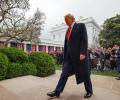
These duties will come into force from April 9.

Stock markets will be driven by RBI's interest rate decision, tariff-related developments, global trends and trading activity of foreign investors in this holiday-shortened week, analysts said.
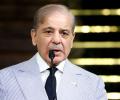
Pakistan's Prime Minister Shehbaz Sharif on Thursday thanked United States President Donald Trump for the 'historic' trade agreement reached between Islamabad and Washington, and expressed hope that it would expand cooperation between the two nations.

'The biggest point of contention is market access for US agricultural and dairy products.'

'The background for the Saudi-Pakistan agreement is the fact that the regional security order has collapsed due to the Israeli attack on Doha.' 'The Americans have largely abandoned their security guarantee for West Asia and the region has no choice but to look at alternatives.'
